Almost everyone who searches contempt divorce has met the same sentence somewhere: that contempt predicts divorce. It is one of the most repeated findings in popular relationship writing, and it is repeated in a form that does something the original research did not do — it addresses the reader. This page is about the gap between those two things.
Contempt is scorn expressed toward a partner: mockery, sarcasm, mimicry, name-calling, the sneer, the eye-roll aimed at them. What follows is what the research says about it, said at the altitude the research actually operates at.
What does the research claim?
That contempt in conflict was among the behaviours associated with marriages that later ended, in samples of couples who were observed and then followed over years. The best-known of this work is the marital-dissolution research of John Gottman and Robert Levenson, whose study of behaviour and marital dissolution recorded couples in conflict and compared what was recorded against what happened to those marriages afterwards. Contempt is also one of the four patterns the Gottman Institute later popularised as the four horsemen.
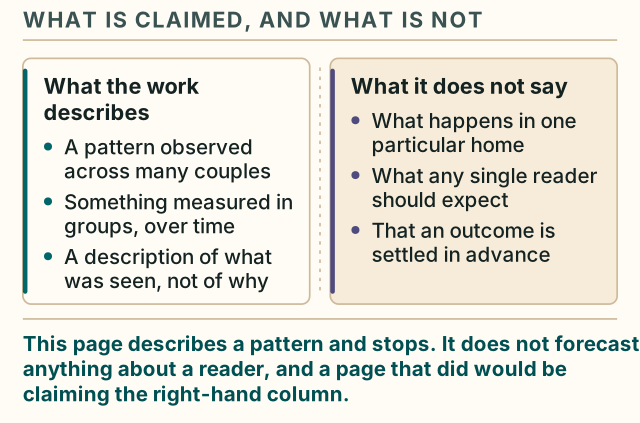
Read that description carefully, because the careful version is the whole point. Couples were recruited. Their conflict conversations were coded. Some of those marriages ended, and the coded behaviour of the couples whose marriages ended differed from the coded behaviour of the couples whose marriages did not. Everything in that account is about a group.
Marital dissolution refers to the outcome the studies tracked — that a marriage ended within the follow-up window — and not to any judgement about whether it should have. The research measured what happened, not what was best for anyone.
You will notice that this page carries no figure. That is deliberate and it is site policy: we publish a number only after we have opened the source that produced it and confirmed that the number says what it is quoted as saying. The accuracy figure attached to this research is the single most reworded statistic in relationship writing, and until it clears that check it is not going on this page. What we can list is the research itself, on our sources page.
What does “predictor” mean?
A predictor is a variable that improves guesses about an outcome across many cases. It is not a cause, and it is not a prophecy about any one case. A predictor is something that shifts the odds for a population; it tells you which way to bet across a crowd, and it says nothing certain about the individual you are looking at.
Consider a weather forecast for a region. A forecast of rain across a county is a real, checkable claim, and it can be right about the county while your particular street stays dry — and the forecast was not wrong. Group-level statements and individual outcomes are different kinds of statement, and one does not convert into the other by being read harder.
A group-level finding means a result that holds when many cases are averaged together, and that carries no guarantee for the next case you meet. Everything in the divorce-prediction literature is of this kind. For instance, in any sample where a behaviour predicts an outcome, there are couples who showed the behaviour and stayed together, and couples who showed little of it and separated. Those couples are not exceptions to the finding. They are part of what the finding is made of.
There is a second thing “predictor” does not mean. It does not establish that the behaviour caused the outcome. Observational research of this kind records what goes together, and scorn in an argument may be the visible surface of something else that was already happening. The research is careful about this. The slogan is not.
Why contempt in particular?
Because of what it does to repair. Every long relationship accumulates unresolved things; what distinguishes the ones that keep working is usually not the absence of conflict but the presence of a way back — the joke that lands, the apology that arrives, the subject change both people accept. Repair requires that each person still counts the other as a peer whose objection is worth answering.
Contempt removes exactly that footing. It is not a harder version of criticism; it is a different geometry. A criticism can be contested, conceded or converted back into the complaint hiding inside it. Scorn offers nothing to answer, because it is not asking for anything. Over time, a couple that cannot repair is a couple whose disagreements do not end, they only pause — which is a plausible reason the pattern keeps turning up in the research on marriages that ended. Why contempt shows up in the first place is a separate question, covered on feelings of contempt.
What can this not tell you about your marriage?
Anything. That is not modesty and it is not a disclaimer bolted on at the end; it follows directly from what the research is.
The studies observed couples who were recruited into them, not you. They coded conversations that were recorded, not the argument you had on Sunday. They reported what happened to a set of marriages over a period, not what will happen to yours. Imagine handing your own situation to one of those researchers and asking for your answer: the honest reply would be that their work does not produce answers of that shape, for anybody.
Temptations come out of this in both directions, and both are worth resisting. The first is reassurance: the statistic is only about groups, so it means nothing. It means something — the research is real, and scorn in conflict is worth taking seriously on its own terms. The second is the sentence this page exists to interrupt: we do this, so we are going to divorce. No study said that about you, because no study was about you.
Where does this page stop?
Where this page stops. This page describes a pattern in how people talk to each other. It cannot tell you what is happening in your relationship, whether it is safe, or what you should do. It is not therapy and not a substitute for it. If you are frightened of your partner, a page is the wrong tool — talk to someone who can hear the specifics.
What this page will not do
- Quote the famous accuracy figure
- The prediction percentage attached to this research is the most reworded number in the field. We publish a figure only after opening the source that produced it and confirming that it says what it is quoted as saying. This one has not cleared that check.
- Estimate your odds
- There is no arithmetic that turns a finding about a studied sample into a probability for one marriage. Anything offering you a percentage for your own relationship is inventing it.
- Tell you whether to stay
- That decision needs your history, your circumstances and your safety. We have none of it. A page that answers it anyway is guessing, and guessing here is expensive.
- Cover divorce itself
- Legal process, money, custody and the phrase contempt of court are all outside what this site is. We describe one communication pattern and stop there.
If what brought you here was a partner’s scorn rather than the research question, when your partner treats you with contempt is the page written for that. The pattern as a whole is on the main page.