The word arrives in most relationships secondhand — from a book, a counsellor, a comment thread — and it arrives with weight. It is worth knowing exactly what it does and does not claim before applying it to a person you live with.
Contempt in a relationship means treating a partner as a lesser person and letting that show in how you speak to them. That is the whole definition. The two halves both matter: a ranking, and its expression. Neither one on its own is what the word describes.
This page is the boundary page for the term. We keep to the relationship sense of the word; the general dictionary sense, its legal use, and its history belong somewhere else.
What does contempt mean in a relationship?
It means speaking to a partner from above them rather than to them. The subject of the sentence stops being a thing that happened and becomes the kind of person they are.
The clearest way to see it is by substitution. You have not looked at the bank statement in three weeks and I need help with it is a request with a person attached. Right, because you are so good with anything that involves numbers is a rating with a person attached. Both sentences can be said in the same tone at the same kitchen table. Only one of them can be answered.
Contempt, in this sense, is not an emotion word at all. It names a move made in language: the speaker assigns themselves a higher position and delivers the complaint from there. That is why people can identify it in a transcript without having been in the room.
“It must be nice to be able to just forget things.” — downward comparison
Two words describe what the line does. It is not an accusation, it does not ask for anything, and it establishes that one person in the conversation is the sort who remembers and the other is not.
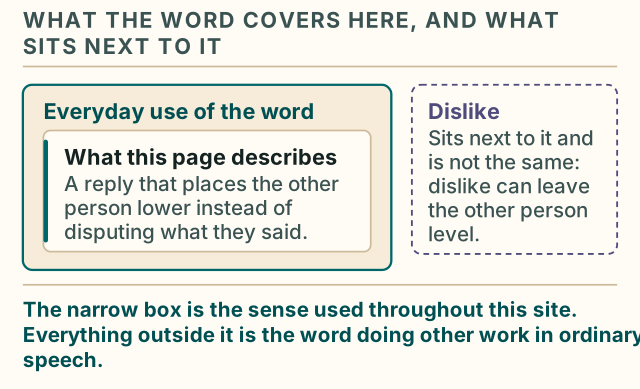
What does the word cover?
It covers a wide range of delivery, from a joke to open dismissal, unified by the ranking underneath.
At the light end sits sarcasm — praise that means its opposite, delivered so that objecting to it makes you humourless. Then mockery: imitating a partner’s voice, repeating their words back with a twist, the exaggerated impression of them worrying. Then correction in front of others, which adds an audience to the ranking. Then dismissal, which is contempt with the effort removed — sure, whatever — and name-calling, which states the verdict plainly.
The wordless versions count too, and for many people they are the ones that stick: the eye-roll in the middle of an explanation, the sigh timed to land on a particular word, the small smile directed at somebody else in the room. For example, a partner who answers every account of your day with a glance at their phone and a mm is communicating rank as clearly as any sentence would.
One useful check on all of this is whether the line would survive being read back. Sarcasm, mockery and dismissal depend on delivery — on tone, timing and the face that goes with them — which is why the person on the receiving end so often ends up unable to explain what was wrong, and why I was joking works as a defence. Imagine writing the sentence down and handing it to the person it was aimed at. The lines that still land badly on paper are the ones carrying a ranking rather than a mood.
Our worked list, with a non-contemptuous version of each complaint written beside it, is on examples of contempt in a relationship.
What does the word not cover?
A great deal. The term is specific, and it is misapplied more often than it is applied.
It does not cover anger. Anger is a demand that something change, and it is usually specific about what: it can be loud, unfair and badly timed while still being aimed at an event rather than at a person’s worth. The full comparison, including where the two overlap, is on contempt vs anger.
It does not cover criticism. Criticism is an attack on a behaviour, or at its worst on a character trait, that is still trying to get something moved. Contempt has stopped asking. Take the difference between you never plan anything and planning is beyond you — the first is an overstated complaint you could argue with, the second is a rating you cannot.
It does not cover a bad mood, a short answer at the end of a hard week, or one sarcastic remark in an otherwise ordinary decade. Every relationship contains sentences that would look terrible in a transcript. What the word describes is a pattern, not a bad Tuesday.
It does not cover conflict as such. Couples who argue frequently are not, by that fact, doing any of this; some of the most durable relationships are noisy ones. What the word tracks is the direction of a sentence, not its volume.
And it does not cover disagreement, however sharp. Two people can hold incompatible positions and argue them at volume without either taking a position above the other.
Getting these boundaries right is not pedantry. The word is heavy, and applied to a partner it functions as a verdict — which is the exact move it describes. Naming a pattern in a conversation is a different act from assigning someone a category, and only the first one leaves the conversation open.
The two neighbouring words that cause the most confusion are resentment — the stored, accumulating version, covered on contempt vs resentment — and disdain, which is close enough to be worth its own comparison on disdain vs contempt.
Where does the relationship sense of the word come from?
Largely from the Gottman Institute, whose description of the four horsemen gave the word its current place in relationship vocabulary by naming contempt as one of the conflict patterns its research team observed and treating it as the most serious of them. The popular-book version of the same model is The Seven Principles for Making Marriage Work (publisher page).
That lineage is why the word carries more alarm than its dictionary meaning would suggest. When someone says there is contempt in my marriage, they usually mean something closer to I have read that this one is serious than I looked up a definition. Every source we cite is listed on sources.
One boundary is worth stating explicitly because people arrive at this page having been handed the word by somebody else. Being told you are being contemptuous is not the same as the pattern existing, and neither is recognising two of your own sentences in a list. A pattern, in the sense this site uses the word, is behaviour that recurs, gets noticed, and goes unanswered — not a single instance and not a bad month. Anyone can produce a contemptuous sentence under enough strain. The term earns its weight only when the sentences have become the normal way a disagreement gets handled, and no page, including this one, is in a position to judge that from outside.
Does contempt mean a lack of respect?
It is a lack of respect that has become audible. Disrespect can sit quietly in a relationship for years — not asking, not listening, deciding without checking. Contempt is the version that gets expressed, and expression is what makes it a communication pattern rather than a private attitude.
The reciprocal framing is useful here, because respect in this context is not a feeling either. It is a working assumption: that the person you are talking to is your equal and their answer might change your mind. Consider what happens to a conversation once that assumption goes. The other person’s reasons stop being information and become a performance to be sat through, and at that point the argument is decorative — the verdict was reached before it started.
That is the plainest reason the word is treated as serious. Not because it is the cruellest thing people say to each other, but because it removes the premise conversation runs on. The full picture of the pattern, including what reduces it, is on the main page.