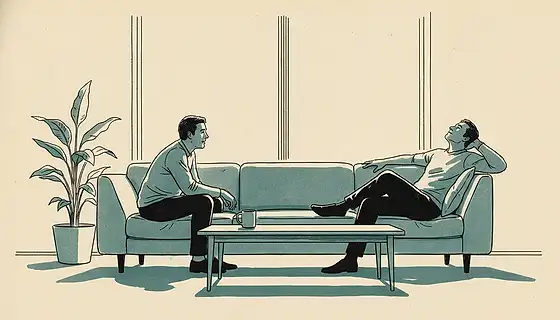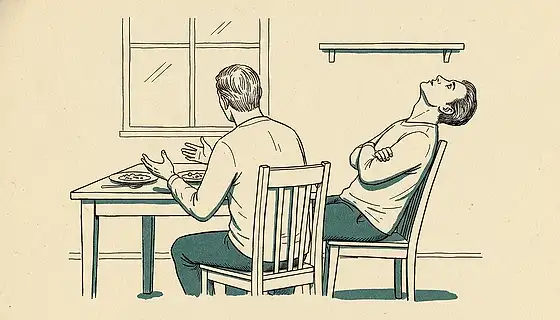
Most people looking up the contempt micro-expression are not doing research. They saw a face do something for an instant, the conversation carried on, and it has not left them since.
A micro-expression is a facial movement brief enough that the person watching may not consciously register it, and the person making it may not have chosen it. The idea comes from Paul Ekman and Wallace Friesen’s 1969 paper on nonverbal leakage, which is where the concept originates — that paper was clinical research on concealment, not a study of couples, and it is cited here for provenance and nothing else. The contempt expression is the asymmetric one, in the description used by the research tradition that catalogues facial movement: the Facial Action Coding System, which Ekman and Friesen published in 1978 as an anatomically based way to describe any visible facial movement. A single lip corner tightened and drawn back and slightly up, with the other side of the face comparatively still.
It is worth being exact about what that tradition is. FACS describes movement; it does not assign emotions to faces. The step from a movement to a named feeling is a separate claim, made by separate research, and it is far less settled than the popular version suggests. The expression itself has been studied directly — Matsumoto and Ekman’s work on the expressions, labels and descriptions of contempt is the peer-reviewed anchor for saying that observers across languages and samples have been asked to label this configuration. The paper usually treated as canonical, Ekman and Friesen’s 1986 report of a contempt expression, sits behind a publisher’s authorisation wall, so we name it rather than link it. And whether the configuration actually communicates contempt to the people looking at it is disputed: Widen and colleagues tested the proposed contempt expression directly and did not find the clean result the popular account assumes. That is an open argument in the field, not a debunking, and this page is written to sit inside it rather than on one side of it.
This page describes what that tradition described. It is not a method for reading your partner, and the section headed What does seeing it not tell you? is the part we would ask you to read if you only read one.
What does the contempt expression look like?
One corner of the mouth tightens and pulls back and up; the rest of the face does much less. In plain terms it reads as a half-smile, a smirk, or a lip pulled sideways — the shape a face makes when someone is not quite smiling and not quite not.
Described more slowly: the movement is small and horizontal rather than broad and upward. A smile widens the mouth on both sides and usually involves the eyes. This does neither. The mouth is narrower, the pull is toward the ear on one side, and the eyes may be entirely uninvolved, which is part of why the expression reads as cold to people who see it.
One more thing is worth saying about the shape, because it is the part that makes people uncomfortable: the movement is small. It is not a grimace or a sneer of the kind a stage direction would call for. It is a fractional pull at one side of a mouth, which is why it is so often described as something the observer nearly missed and then could not stop thinking about.
Asymmetry here means that the two sides of the face are doing different things at the same moment. That is the single feature most descriptions lead with, and it is the one you can actually notice without training.
Why does one-sidedness matter?
Because the other expressions in the same catalogue are broadly symmetrical, and this one is not. Anger, fear, surprise and disgust — the short list Ekman argued for as basic emotions — are described as pulling both sides of the face in roughly the same way. Contempt is the one whose signature is that it does not.
That position is Ekman’s, and it is contested rather than agreed: when Crivelli and colleagues took the same task into two small-scale societies, people did not sort faces into those categories the way the universality account predicts. So read the asymmetry as the distinguishing feature of a described configuration, not as a fact about all human faces everywhere.
That has a practical consequence for anyone trying to name what they saw. You are unlikely to remember which muscles moved. You are quite likely to remember that the face did something on one side. When people describe an expression they cannot forget, the detail they usually reach for is that it was lopsided — and that is not a coincidence.
For example, someone recalling an argument will say he half-smiled at me far more often than they will describe a mouth position. The half is the whole memory.
There is a second reason the asymmetry gets attention, and it belongs in the honest column rather than the impressive one. Because one-sidedness is easy to describe, it is easy to over-teach: an audience that learns to look for a lopsided mouth will start finding lopsided mouths, including on faces that are chewing, concentrating, or built slightly unevenly. A feature that is easy to spot is not the same as a feature that is reliably meaningful.
It is worth being clear about what this does and does not establish. That the expression is asymmetric is a description of a movement. It is not, by itself, evidence about what a person feels, means, or intends.
What do people mean by “the look of contempt”?
The look of contempt, in ordinary speech, means being looked at as though you are beneath comment — and it usually refers to a whole moment, not a muscle. It is the phrase people use when what they remember is not a sentence but a face, and the face made a conversation feel already decided.
The phrase does a lot of work precisely because it is imprecise. It bundles the expression with the pause before it, the tone of whatever came next, and the room it happened in. Consider how people actually report it: rarely as I observed an asymmetric lip movement, almost always as the way he looked at me when I said it. The context is not decoration around the expression; in most reports it is doing most of the lifting.
Signature
What the look usually arrives with
No, go on. Finish.
invites, then withdrawsThe words grant the floor and the delivery withdraws it, which is why the face is what gets remembered.
Anyway.
closes the topicA single word ends the exchange without answering it, leaving the expression as the whole message.
Sure. Whatever you think.
concedes downwardAgreement is given in a form that costs nothing and settles nothing, and the ranking is carried by tone rather than content.
Lines are composites written for illustration, not transcripts of real people. Naming what a line does is not a judgement about who said it.
What does seeing it not tell you?
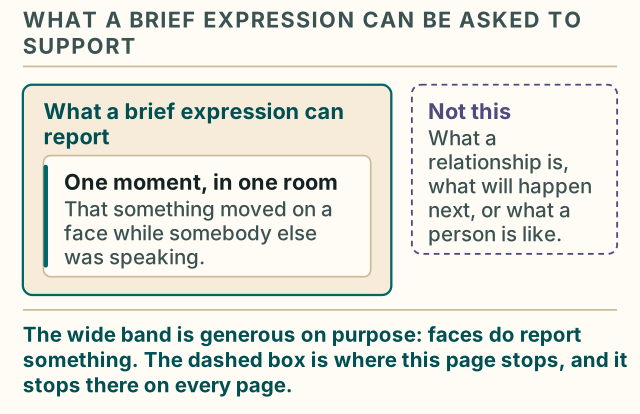
It does not tell you what the other person thinks of you, and it is not evidence you can rely on in an argument. A face is one signal, arriving fast, with no label attached, in a situation where you already have a theory — which is the condition under which people are least accurate about anything.
What this page will not do
The micro-expression literature is the most over-claimed corner of this topic. Here is where we stop.
- Give you a duration
- A specific fraction of a second is quoted everywhere online. We are not repeating it, in any wording, until we can cite a primary source we have opened. An unsourced figure that everyone knows is still an unsourced figure.
- Teach face-reading
- There is no method on this page for detecting what a partner is concealing. Emotion recognition is contested among specialists working from recordings; it is not a skill to deploy on someone you live with.
- Turn an expression into a verdict
- One expression is not a diagnosis of a person or a relationship. People misread faces routinely, especially the faces they are already worried about.
- Cite past what a source says
- The work linked on this page is linked for what it actually establishes: where the coding system came from, that the expression has been studied and labelled, and that whether it communicates contempt is still disputed. None of it is offered as evidence about a particular face.
Imagine the same half-second played back with the sound on and the hour before it restored: the same movement can belong to a joke made two sentences earlier, to a person who has stopped listening, or to someone who is holding back something unrelated to you. The movement does not change. What you would conclude from it does.
The stronger reason for caution is not that observers are unreliable in general. It is that you are not a neutral observer of this particular face. If you have been braced for dismissal, ambiguous movement resolves toward dismissal — and a tired face, a face concentrating, or a face reacting to something you did not see all become available as confirmation.
What if you keep seeing it?
Then the useful information is the pattern, not the face. A single expression is ambiguous by nature; what happens repeatedly, in conversations you can describe, is something you can actually talk about — and it is talkable precisely because it does not require anyone to agree about what a face meant.
The other reason to move attention from the face to the pattern is that the face invites a fight nobody wins. Bringing an expression into a conversation puts you in the position of describing somebody’s involuntary movement back to them, and the available replies — I did not, that is just my face, you are watching me now? — are all worse than where you started. What happened repeatedly, in words, has none of that problem.
If that is where you are, being treated with contempt is the page written for it. For the rest of the body rather than the face, see contempt body language; for how the static expression differs from anger and disgust, see contempt versus anger. The pattern as a whole is described on the main page, and every source we cite is listed on sources.