Contempt in a relationship is scorn aimed at a partner — mockery, sarcasm, mimicry, name-calling, the eye-roll — delivered from a position above them rather than across from them. It is one of the four conflict patterns the Gottman Institute popularised as the four horsemen.
Some questions about it do not belong to any one page on this site. They cut across several, or they arrive before a reader knows which page to look for. This page collects them. Every answer below is written to stand on its own, and each one links to the page where the topic gets full treatment.
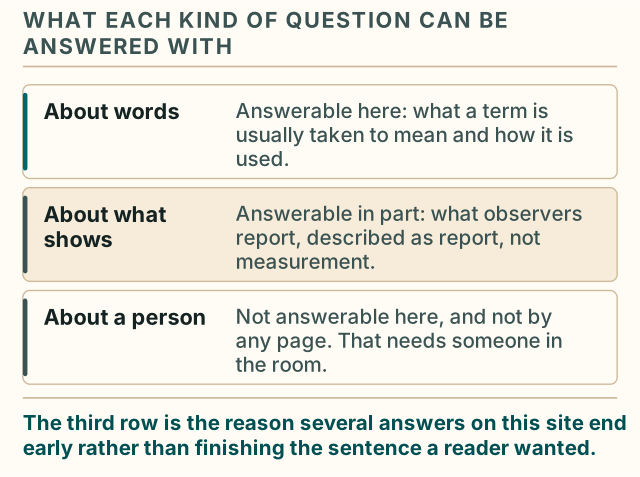
Nothing here assesses a relationship, ranks anyone, or tells you what to do. We describe a communication pattern; that is the whole scope, and it is set out on our editorial policy.
What is contempt, and can it be undone?
What triggers contempt?
Contempt in a specific moment is usually triggered by something small that stands for something old — a familiar tone, a repeated mistake, a subject that has been argued before without landing. The trigger is rarely the cause. Where the scorn came from originally is the subject of feelings of contempt.
What creates contempt in a relationship?
The pattern is generally described as accumulating rather than appearing: grievances raised and not resolved, then stopped being raised; admiration eroding quietly; scorn learned as an ordinary register somewhere else and imported. Contempt is what is left when a complaint has been abandoned as pointless. That process is described in full on feelings of contempt.
Can relationships recover from contempt?
Contempt is described as a behaviour rather than a permanent condition, and behaviours change when both people want them to. The direction of the work is usually described as rebuilding regard and restoring repair — the subject of Sue Johnson’s Hold Me Tight. What no page can tell you is whether a particular relationship will. The pattern and its counter-move are set out on the main page.
Can marriages recover from contempt?
Same answer, with one addition specific to marriage: the research that made contempt famous studied marriages over time and reported what happened to a group, not what will happen to yours. What that distinction means, and why no honest page will give you odds, is on contempt and divorce.
How do you recognise contempt?
What are signs of contempt?
Sarcasm used as a normal register, mimicry of a partner’s voice, name-calling in a light tone, corrections delivered in front of other people, and the eye-roll aimed at a partner mid-sentence. The recognisable feature is the altitude rather than any single gesture. The lines themselves are collected on examples of contempt.
What are the signs of contempt in relationships?
Much of it is not spoken at all. Contemptuous body language refers to the dismissals carried by posture, distance, tone and timing — the turn away mid-sentence, the sigh released with the shoulders, the phone picked up as an answer. Those signals are described on contempt body language.
What is an example of contempt in a relationship?
For example: one partner explains why they handled something a particular way, and the other answers “wow, you really thought that would work.” The words are praise; the delivery is a ranking. What makes that contempt rather than a complaint is set out on what contempt means.
What are some examples of contempt?
Mockery means repeating a partner’s words, voice or manner so that they sound absurd, and it is the purest form of the pattern because it contains no argument at all. Mock admiration. Repeating a partner back in a higher voice. An insult delivered as banter, with you know I’m kidding attached. A correction made with a glance around the table. The eye-roll aimed at the person still speaking. Each one is unpacked, with the non-contemptuous version of the same grievance, on examples of contempt.
What are some examples of contempt in a marriage?
In a long marriage it usually gets quieter. Consider the practised sigh before a familiar story, the shorthand nickname for a partner’s habits used in company, or the question asked of one person and answered by the other. The marital forms are described on examples of contempt.
What does “look with contempt” mean?
Used about a fleeting expression, it names the flicker that crosses a face and is gone before anyone could point at it — a brief one-sided tightening around the mouth, often while the other person is still talking. What can and cannot be read from that flicker is covered on the contempt micro-expression.
What is contempt not?
What does it mean to look with contempt?
As a description of a held expression rather than a flicker, it means answering with the face instead of a sentence: the raised brow, the one-sided lift of the mouth, the eye-roll. Why that face reads as contempt rather than as anger or disgust is on contempt vs anger.
How to tell if someone feels contempt?
You can describe what a person does; you cannot read what they feel, and this site does not pretend otherwise. What is observable is a dismissive register that persists between arguments, not only inside them. Telling that apart from ordinary anger is the subject of contempt vs anger.
Everything we cite is listed on our sources page, including a note on the pages that carry no external source and why.