Contempt body language refers to the postures, movements and sounds people describe when contempt is present in a conversation without being stated: the turn-away mid-sentence, the audible exhale, the glance at someone else while a partner is still talking.
This page describes those behaviours because readers ask what they look like. It does not turn them into a test. The last thing this topic needs is another list that promises to tell you what your partner thinks — so the section on why posture is weaker evidence than it feels is not a disclaimer at the bottom, it is the middle of the page.
What does contempt look like without words?
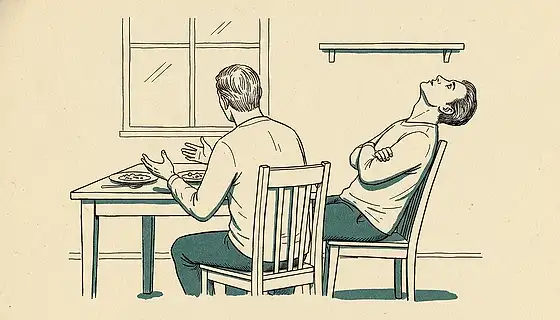
It looks like attention being redirected while someone is still speaking. The behaviours reported most consistently share that shape: the body, the eyes or the voice go somewhere else before the sentence has finished.
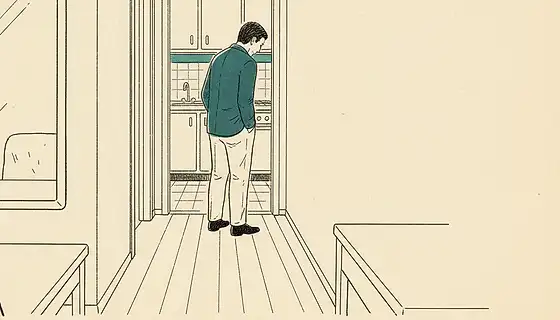
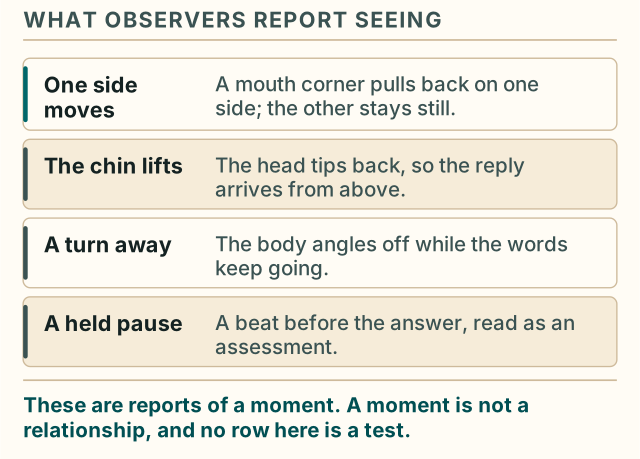
The turn-away is the one people name first: a reorientation of the body away from a partner before they have finished speaking. The recurring behaviours, described as behaviour rather than as evidence:
- The turn-away. The shoulders or the whole body reorient mid-sentence — toward a screen, a door, a task — while the partner is still mid-thought.
- The audible exhale. Not a sigh of tiredness but a short one aimed at the moment, timed to land in the pause before a reply.
- The glance elsewhere. Eyes go to a third person in the room while a partner speaks, inviting someone else into the assessment.
- The eye-roll. The gesture most associated with contempt in popular writing, and the one most often produced by pure habit.
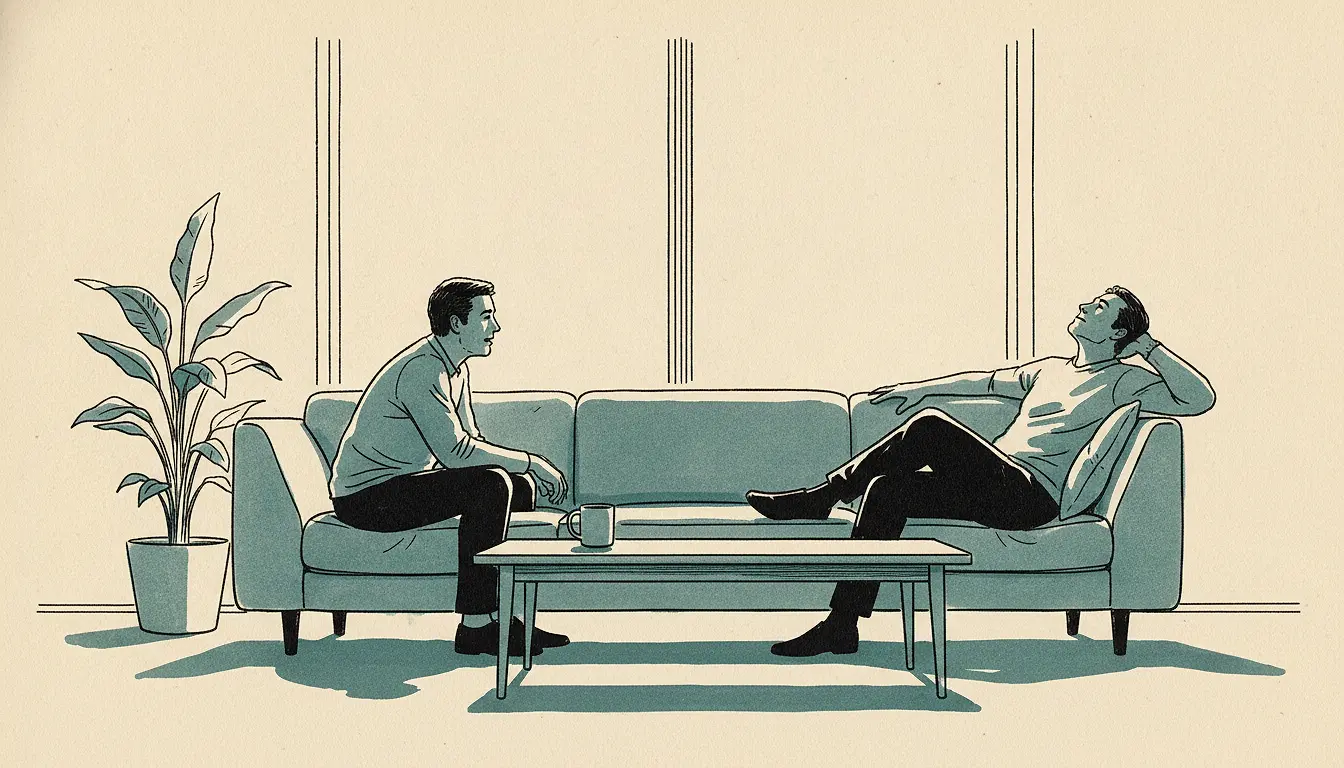
- The stillness. A face and body that stop responding entirely, so that speaking into it feels like speaking into a wall.
For example, one partner is describing something that happened at work and the other, without saying a word, turns back to the washing-up before the story ends. Nothing was refused. Nothing can be quoted. And both people know what happened.
What does contempt sound like?
It sounds like a reply that costs nothing. The vocal signals people describe are cheaper than arguments: they end an exchange without engaging it, which is precisely what makes them hard to answer.
Signature
The sound of it
Mm-hm.
acknowledges without receivingThe response is technically listening and structurally a door closing.
So you were *tired*. Right.
flat repeat-backThe partner's own word is returned unchanged, and the flatness does the ranking that no added word would.
Ha.
prices the remarkA single syllable rates what was said without responding to it, which leaves nothing specific to dispute.
Lines are composites written for illustration, not transcripts of real people. Naming what a line does is not a judgement about who said it.
The flat repeat-back is the most distinctive of these: your own sentence returned to you in a voice with the interest removed. It is worth naming because it is the one vocal move that is hard to attribute to tiredness — repeating someone requires having listened.
What these sounds have in common is that they are unfalsifiable. An argument can be answered, a complaint can be conceded, a raised voice can be apologised for the next morning. A syllable cannot. There is nothing in ha to disagree with, which is why people on the receiving end of it so often describe feeling that the conversation was over before they noticed it starting.
Tone is also where the two people in a room disagree most sharply about what happened. The words are recoverable and everyone agrees on them; how they were said is not, and that becomes its own argument. I never said that and it was not what you said are both true statements, and neither one gets anybody anywhere.
If you want the same material in sentences rather than sounds, examples of contempt collects the lines themselves.
Why is body language weaker evidence than it feels?
Because the same posture means several things, and you are not in a position to sort between them. A turned shoulder is produced by dismissal, by a bad day, by pain, by a task that genuinely could not wait, and by the habit of half-listening that most households run on by Thursday.
Contempt does get identified by observers, but it is worth being precise about the conditions. In research on couples it is a category that trained raters assign to recorded conversations, using a coding scheme built for the purpose and evaluated for whether it holds up — the psychometric evaluation of the Specific Affect coding system is where that machinery is examined. Note what that involves: a recording, a scheme, a trained coder, and time. It is not the same activity as forming an impression of your partner across a kitchen while the conversation is still happening, and nothing in that literature says a gesture identifies an emotion. The related idea that feeling leaks out through behaviour the person did not choose comes from Ekman and Friesen’s 1969 paper — cited here only for where the idea comes from, since that work was about concealment in clinical settings, not about couples, and it establishes nothing about reading a partner.
Everything else on this page is our description of behaviour readers report, and it carries no citation because there is none to carry: we found no source establishing that contempt can be read from posture or gesture. We would rather say that plainly than attach a study to a sentence it does not support.
What this page will not do
Body-language content is the easiest place on this topic to overclaim, so here is the boundary.
- Give you a percentage
- A well-known figure about how much of communication is nonverbal circulates everywhere and is not in our approved facts. We will not repeat it in any wording, including an approximate one.
- Offer a reading system
- There is no checklist here that converts gestures into conclusions about a person. Systems like that are confident in inverse proportion to their evidence.
- Diagnose anyone
- Behaviour observed across a kitchen is not an assessment of a partner or a relationship, and this page cannot make one.
- Claim posture identifies an emotion
- The sources linked on this page cover how researchers code recorded conversations and where the idea of nonverbal leakage came from. Not one of them establishes that contempt can be read from a gesture, and we will not stretch them into saying so.
The asymmetry is worth stating plainly: the behaviours on this page are much better at describing something once you already have other reasons to think it is happening than at establishing it from nothing. As description, the turn-away and the flat repeat-back are useful — they give a name to something that was otherwise a bad feeling with no words attached. As evidence, they are thin.
The problem compounds because expectation shapes perception. Once you are watching for dismissal, ambiguous behaviour resolves toward dismissal, and every additional evening supplies more ambiguous behaviour. That is how a person can accumulate a great deal of certainty from evidence that would not convince anyone else. Reading other people is not hopeless — a meta-analysis of emotion recognition across cultures found that people do read expressions better than chance — but the same work found accuracy rises when the reader and the person being read come from the same cultural group, which is a plain reminder that who is doing the looking changes what gets seen. None of that was measured on a partner you have a history with, in a room where you already have a theory.
Imagine handing a recording of one evening to someone who does not know either of you. They would see a person turn toward the sink. They would not see what you saw, and that gap is not proof they are missing something — it is a measure of how much of the meaning you are supplying yourself.
What survives this caution is the pattern. A pattern, as we use the word here, means something that repeats across many separate conversations and can be described in specifics, such as being answered shorter than other people are answered or being corrected in front of company. That is something worth taking seriously. A single gesture on a single night is not, however sure it felt.
What if you recognise these in yourself?
Then you have information that is more reliable than anything you can gather by watching someone else — because you know what you meant, and no observer does. The exhale you can hear yourself producing, the reorientation toward the sink, the syllable instead of an answer: those are facts about your own behaviour rather than inferences about another person’s mind.
That is a genuinely better starting point, and it is also the harder one to sit with. Most people arrive at a page like this looking for a lens to point outward. Pointed the other way, the same descriptions stop being a test and become a description of something you can change without needing anyone’s agreement first. We are not going to prescribe how, because we cannot see your situation and would be inventing the specifics.
Is the face a separate question?
Yes — the face has its own literature and its own overclaiming, so it has its own page. The fleeting expression, the asymmetric smirk and the phrase the look of contempt are covered in the contempt micro-expression, including the figures we decline to repeat there.
The short version is the same as here: the expression is describable, the description is interesting, and neither of those makes it a verdict about a person. It is also less settled than it sounds — Widen and colleagues tested whether the proposed contempt expression communicates contempt and found the question genuinely open, which is a reason to hold the face loosely even before you get to everything posture cannot tell you. The whole pattern is set out on the main page, and every source we cite anywhere is listed on sources.