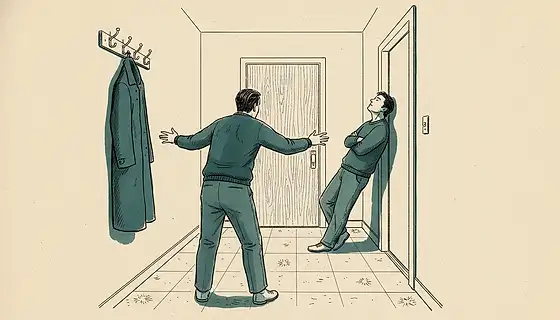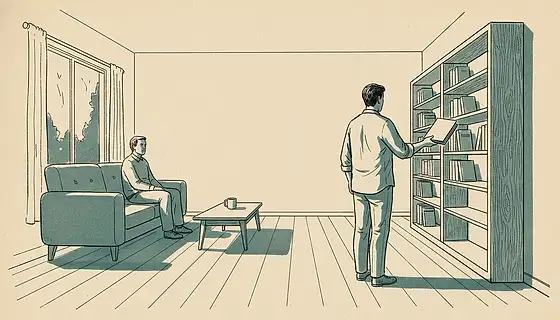
Most people searching contempt vs resentment already know both words and use them interchangeably. Inside a relationship they describe two different positions, and the difference is not intensity. Resentment is a grievance held against a person you still regard as your equal — someone who owes you something and could, in principle, pay it. Contempt is what is left when the grievance has become a settled opinion about who that person is, so that nothing they do next counts as new evidence.
That is the whole distinction, and it survives every example below. Resentment is unfinished business. Contempt is business considered closed.
| Resentment | Contempt | |
|---|---|---|
| What it is about | An act, or a run of acts | The person who did them |
| Where it looks | Backward, at the record | At the person in the room now |
| What it wants | Acknowledgement, or repayment | Nothing — the question is settled |
| How it sounds | Bookkeeping, delayed agreement | Ranking, mockery, correction in public |
| Whether it can be answered | Yes, the grievance is nameable | Not directly — a verdict is not a claim |
What is the difference between contempt and resentment in one line?
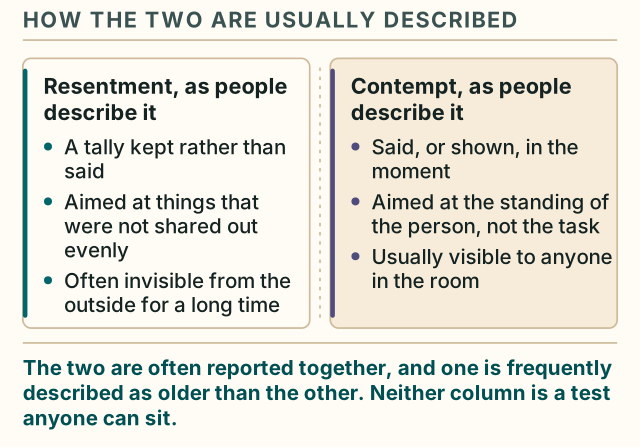
Resentment still argues with an equal; contempt has stopped treating the other person as one. Resentment carries a running account of what was done and left unsaid, and it is oriented toward the past. Contempt is oriented toward the present person: it places them lower, and it usually shows.
The reason the line matters is practical rather than academic. A grievance can be brought into the open, disputed, corrected, or conceded. Once the grievance has hardened into an opinion about the other person’s worth, there is nothing specific left on the table to dispute. Two people can have a hard, useful argument about who was supposed to call the plumber. Neither of them can have a useful argument about whether one of them is a disappointment.
What does resentment sound like?
Resentment sounds like accounting. Keeping score refers to the habit of carrying an unspoken ledger of what each person has given and taken, and raising entries from it later, usually during an argument about something else. The tell is that the grievance arrives attached to a date, an occasion, or a repeated event.
For example, a conversation about who is picking up a parcel turns into a conversation about a weekend two Augusts ago. The parcel is real and the weekend is real; what makes it resentment is that the weekend was never raised at the time and has been drawing interest since.
Signature
What resentment sounds like
Fine. I will do it. Like the last three times.
opens the ledgerThe complaint is about a count of events, which means the events are still being counted.
No, it is nothing. Go.
banks the grievanceThe grievance is withheld rather than dropped — nothing is forgiven here, only postponed.
I did not say anything then either.
cites the recordThe sentence is evidence of an account being kept, and of the other person not knowing it existed.
Lines are composites written for illustration, not transcripts of real people. Naming what a line does is not a judgement about who said it.
Resentment is often described as quiet, which is only half right. It is quiet in the moment the grievance happens and loud somewhere else — three weeks later, over something small. That displacement is what makes it exhausting for the person on the receiving end, who is answering a charge they did not know had been filed.
It is also why resentment is so often invisible to one of the two people involved. Nothing about the ledger requires the other person to know it exists; in most descriptions, they find out about it long after the entries were made, all at once, in an argument that appears to them to have come from nowhere. That mismatch — one person reading from a record, the other hearing a first draft — is most of what makes these arguments feel unfair from both sides at the same time.
The important feature for our purposes is that everything above is still about acts. The ledger has entries. Entries can be read out, disagreed with, apologised for, or written off.
What does contempt sound like?
Contempt sounds like the same complaint after the verdict. The subject is no longer what was done; it is what kind of person does that. Contempt in this sense means treating the other person as occupying a lower position — less competent, less serious, less worth answering — and letting that position show in how you speak to them.
Consider the parcel again. The resentful version counts: this is the fourth time. The contemptuous version does not need a count, because the count has already produced a conclusion. It says of course you forgot, and the word doing the work is of course.
Signature
The same complaint, after the verdict
Of course you forgot. Why would you not.
closes the caseThe forgetting is presented as confirmation of something already decided, so there is nothing to answer.
It is fine. I will just do it properly after you.
redo-in-front-ofNothing here is an accusation, which is exactly what separates it from a complaint.
Ask him. He knows what she is like.
appeals to an audienceA third person is enlisted, so disagreeing now costs more than the original subject was worth.
Lines are composites written for illustration, not transcripts of real people. Naming what a line does is not a judgement about who said it.
Notice what is missing from those lines: a request. Resentment, even at its most indirect, still implies something the other person could do. Contempt does not, because it is not addressed to someone whose behaviour is expected to change. It is addressed past them.
How does resentment turn into contempt?
By accumulation, and by the complaint changing what it is about. The described sequence is familiar to anyone who has watched a long argument stop being an argument: a grievance goes unraised, then another, then the ledger gets long enough that reading it out loud feels pointless. At that stage the cheapest way to hold the whole account in one thought is to stop holding acts and start holding a conclusion about the person.
A verdict, in the way we use the word on this site, means the moment a complaint stops producing questions. Before the verdict, an unexplained lateness is a thing to ask about. After it, the lateness is simply confirmation. Nothing new can arrive, because the category has already been assigned.
Imagine two people who have had the same argument about money for a year. In the first months, each argument is about a specific purchase and each one is winnable. Somewhere in that year the arguments start opening at the conclusion instead of working toward it — not you spent this, but you are the sort of person who spends. The subject has moved from the account to the person, and the same sentence that used to be a complaint now functions as a ranking.
The mechanism people describe is a kind of economy. Holding a long list of separate grievances is work: each one has to be remembered, weighed and, if it is ever raised, defended. A conclusion about the person compresses the whole list into a single item that requires no maintenance. It is cheaper to carry, and it has the additional property of never being contradicted by anything, because everything that happens afterwards fits it.
That last property is what makes the change hard to reverse from the inside. A person holding resentment can be surprised by evidence; that is what an open account means. A person who has reached a verdict has nothing left that can function as evidence, because the category assigns itself to whatever arrives next.
We are describing what the shift looks like from the outside. We are not claiming a cause, a timeline, or an inevitability — none of that is established here, and this page will not invent it. Plenty of relationships carry long-standing resentment that never becomes contempt at all.
Can contempt go back to being resentment?
The honest answer is that it can be described going the other way, but not promised. The move back is the same move in reverse: turning a conclusion about a person into a statement about something they did, which is small enough to be answered.
Two things make the return harder than the drift. The first is that a verdict is comfortable in a way a grievance is not: it explains everything and asks nothing. The second is that undoing it requires giving up the explanatory power — going back to a state where each new thing your partner does is genuinely undecided, which feels less like relief and more like reopening a file you had finally closed.
In writing about couples, that reversal is usually described as re-specifying the complaint — saying the thing that actually happened, in the smallest form that is true, without the summary of character attached. Sue Johnson, who developed Emotionally Focused Therapy, builds Hold Me Tight around conversations of roughly that shape: the move is to name the specific moment and what it did to you, rather than to deliver the conclusion you have reached about the person. We are pointing at the book, not prescribing it — whether that kind of conversation is available to you depends on things a page cannot see. It is not a technique for changing someone else. It is a change in what is on the table: a specific grievance can be met, and a verdict cannot.
It also matters who is doing it. Everything on this page describes positions people hold, not instructions for changing someone else’s position. A person can re-specify their own complaints; nobody can re-specify another person’s verdict for them, and attempts to do so tend to read as one more thing to be dismissed.
What we will not do is tell you that the reversal works, how long it takes, or what it means about your relationship if it does not. That is beyond what a page can know, and it is the point where this site stops.
If you want the same distinction against a different pair of words, contempt versus anger covers the emotion that is most often mistaken for it, and feelings of contempt covers the view from the inside — what it is like to be the person who has arrived at the verdict. The full description of the pattern is on the main page, and everything we cite anywhere on this site is listed on sources.