Contempt in a relationship is scorn aimed at the person you are closest to: a sentence, a sound or a face that places the speaker above their partner rather than across from them. The examples of contempt in a relationship collected below are ordinary lines said in ordinary arguments — nothing here is exotic, and most of it has been said by someone having a bad week. What makes them examples of contempt is not their vocabulary. It is their altitude.
This page is a recognition tool and nothing more. It does not score anything, it does not count anything, and it will not tell you what is happening in your relationship. It describes how a pattern sounds so that you have words for something you may already have heard.
What do all examples of contempt have in common?
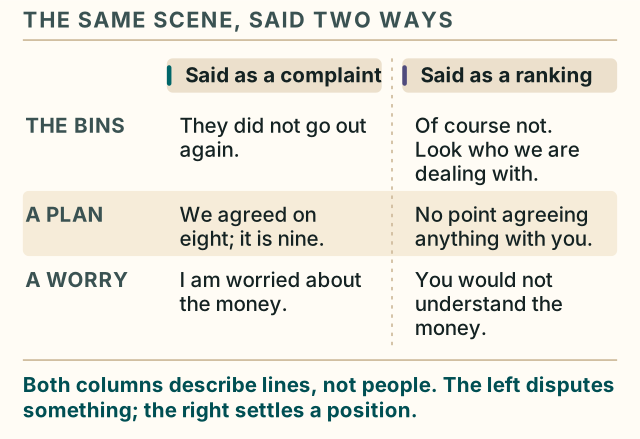
Every example on this page performs the same move: it answers a partner from a position above them. Contempt is the one conflict pattern that is not really about the topic. A complaint is about an event. Criticism is about a person’s character but is still argued between equals. Contempt adds height — the speaker’s settled sense that the partner is a lesser kind of person, and that this was established some time ago. The Gottman Institute’s description of the four horsemen names contempt for exactly this reason, and treats it as the most corrosive of the patterns it describes.
A useful way to read the list below is what you might call the position test. Strip the sentence of its tone and ask what remains. If a real complaint is left underneath — you said you would call and you didn’t — the contempt was the packaging. If nothing remains except a ranking, there was never a complaint in there to answer. That distinction matters, because a complaint can be addressed tonight and a ranking cannot.
What does contempt sound like in a relationship?
Contempt sounds like an answer aimed at the partner rather than at the subject. Below are the recurring forms, each with what it does and the same grievance said without the height.
Signature
What does it sound like out loud?
Wow. You really thought that was going to work.
mock admirationThe praise is the delivery vehicle. The sentence is built so that the only available answer is embarrassment.
It's fine. I'll just do it again after you.
redo in front ofNothing here is an accusation, which is what separates it from a complaint about the dishes.
Ask him. He knows what she gets like.
appeal to an audienceA third person is enlisted, so disagreeing now costs more than the original subject was worth.
Oh, so now we care about the calendar.
reach for the recordThe topic is dropped for a record proving the partner is the kind of person who forgets.
I don't know, ask your mother, she does your thinking.
insult as banterDelivered in the tone of a joke, so objecting to it becomes a second offence.
(repeating the partner back in a higher voice)
mimicryUses no words of its own. What it communicates is that the partner sounded ridiculous.
Sorry — go on. This should be good.
permission from aboveThe floor is granted rather than shared, which is the whole message.
Lines are written for this page as composites of ordinary argument language; they are not transcripts of real people.
Sarcasm. Sarcasm is a sentence whose words say one thing and whose delivery says the opposite, and in a conflict it functions as an insult that can be denied afterwards. “Great, another one of your brilliant systems.” What it does: converts a disagreement about how the kitchen is organised into a verdict about the partner’s judgement. Without the height: “I can’t find anything since we moved the shelves. Can we go back to the old way?”
Mockery and mimicry. Mockery means repeating a partner’s words, voice or manner in a way designed to make them sound absurd. It is the purest form of the pattern because it contains no argument at all. What it does: invites the partner to hear themselves as ridiculous. Without the height: saying the thing you actually disagreed with, in your own voice.
Name-calling, including the affectionate kind. “Don’t be such a drama queen about it.” What it does: files the partner under a type, so that whatever they said next has already been explained away. The soft tone does not change the move. Without the height: “This feels bigger to you than it does to me and I don’t understand why yet.”
Correcting in front of other people. For example: a partner tells a story at dinner and gets a date slightly wrong, and the other corrects it with a glance around the table. What it does: recruits an audience, so that the partner is now outnumbered on a point nobody cared about. Without the height: letting it go, or saying it later, in private, if it mattered.
Hostile humour. The joke that lands on the partner while everyone laughs, followed by “you know I’m kidding”. What it does: delivers the ranking and pre-emptively disqualifies the objection to it. Without the height: jokes that both people are inside.
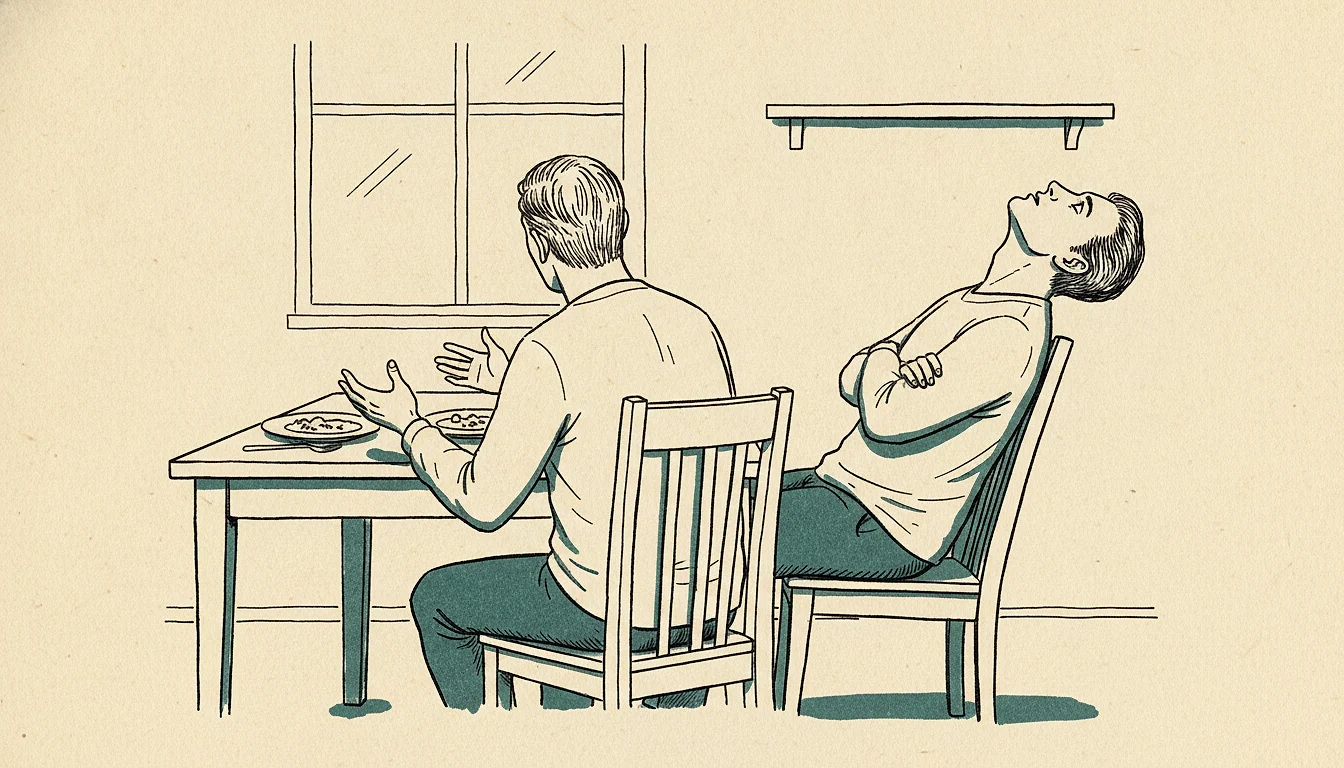
The eye-roll. An eye-roll aimed at a partner refers to the gesture of dismissal made while they are still speaking — the version that answers them rather than the situation. It is the most quoted example of contempt because it is the cheapest: it costs one second and no words. Without the height: staying in the conversation until they finish.
Each of these can be produced by a decent person on a bad day. The pattern is not any single line; it is the register a couple settles into.
Exercise
What is this line doing?
The same seven forms, turned into a reading exercise: a line arrives, you name what it is doing, and then read why.
Nothing is scored, nothing is sent anywhere, and it produces no reading of you or your relationship.
What does contempt look like without words?
It looks like the face and the body arriving before the sentence does. Contempt travels unusually well in the channel around language: the sneer that pulls one side of the mouth, the sigh released with the shoulders, the turn away mid-sentence, the phone picked up as an answer. Most of what people recognise as contempt was never said out loud.
Two neighbouring pages cover that ground properly rather than duplicating it here. Posture, tone, distance and what the hands do belong to contempt in body language; the flicker that crosses a face and is gone before anyone could point at it belongs to the contempt micro-expression.
What does contempt look like in a marriage?
In a long marriage the same pattern usually gets quieter. Open insult is a young argument’s tool; after enough years the couple has shorthand, and contempt compresses into it. Signs of contempt in marriage are therefore easy to miss from the outside and hard to point at from the inside, because everything has a history that makes it look ordinary.
Consider a couple who have told the same story about a disastrous house move for years. Early on, one of them was the hapless one in it and both of them laughed. Now the story gets told with a small sigh first, and the sigh is doing the work: it tells the room that this is what living with him is like, and it does so without a single unkind word. Nothing in that scene would survive being written down as a complaint. All of it is legible to the person it lands on.
The other marital form is the answer given to the room instead of to the partner — a question asked of one person and fielded by the other, routinely, as though the first were not qualified to answer about their own life. Long-married contempt tends to look like a settled division of standing rather than an attack.
What is not contempt?
Plenty. Irritation is not contempt: a sharp tone at the end of a hard day is an argument between equals, and it usually apologises. A badly phrased complaint is not contempt, even when it stings — “you never think about how this affects me” is unfair and overstated, but it is addressed to a peer and it expects an answer. Anger is not contempt either; anger tends to want something from the other person, which is why it is loud — the reading of anger as a signal with a demand inside it is the argument of Harriet Lerner’s The Dance of Anger. Contempt does not want anything, which is why it can be so quiet. That distinction has its own page, as does the slower feeling that often precedes it, resentment.
Imagine reading this list and recognising three lines from last Tuesday. That recognition is not a diagnosis and this page will not turn it into one. There is no threshold here, no count that means something, and no version of this list that ends with a verdict — partly because we do not know your relationship, and partly because lists that score people are wrong often enough to do real harm. What a recognition is good for is naming the specific thing you want to talk about instead of arguing about the dishes again.
Where does this page stop?
Where this page stops. This page describes a pattern in how people talk to each other. It cannot tell you what is happening in your relationship, whether it is safe, or what you should do. It is not therapy and not a substitute for it. If you are frightened of your partner, a page is the wrong tool — talk to someone who can hear the specifics.
What contempt is, where the term comes from, and the direction the counter-move points are set out on the main page. The published work we draw on is listed on our sources page.