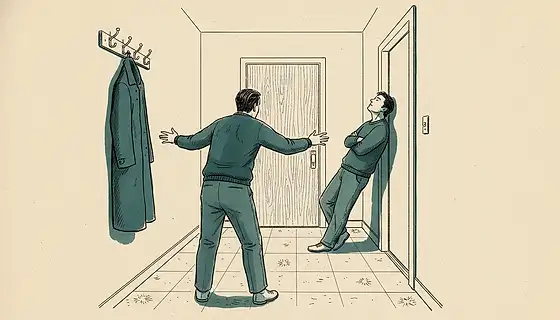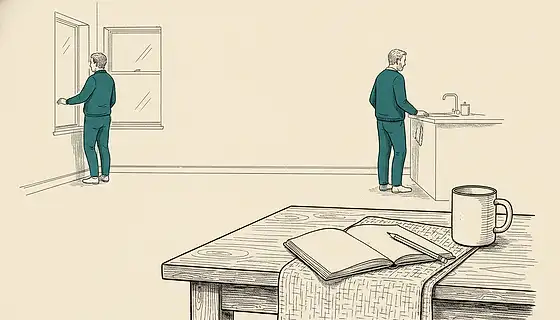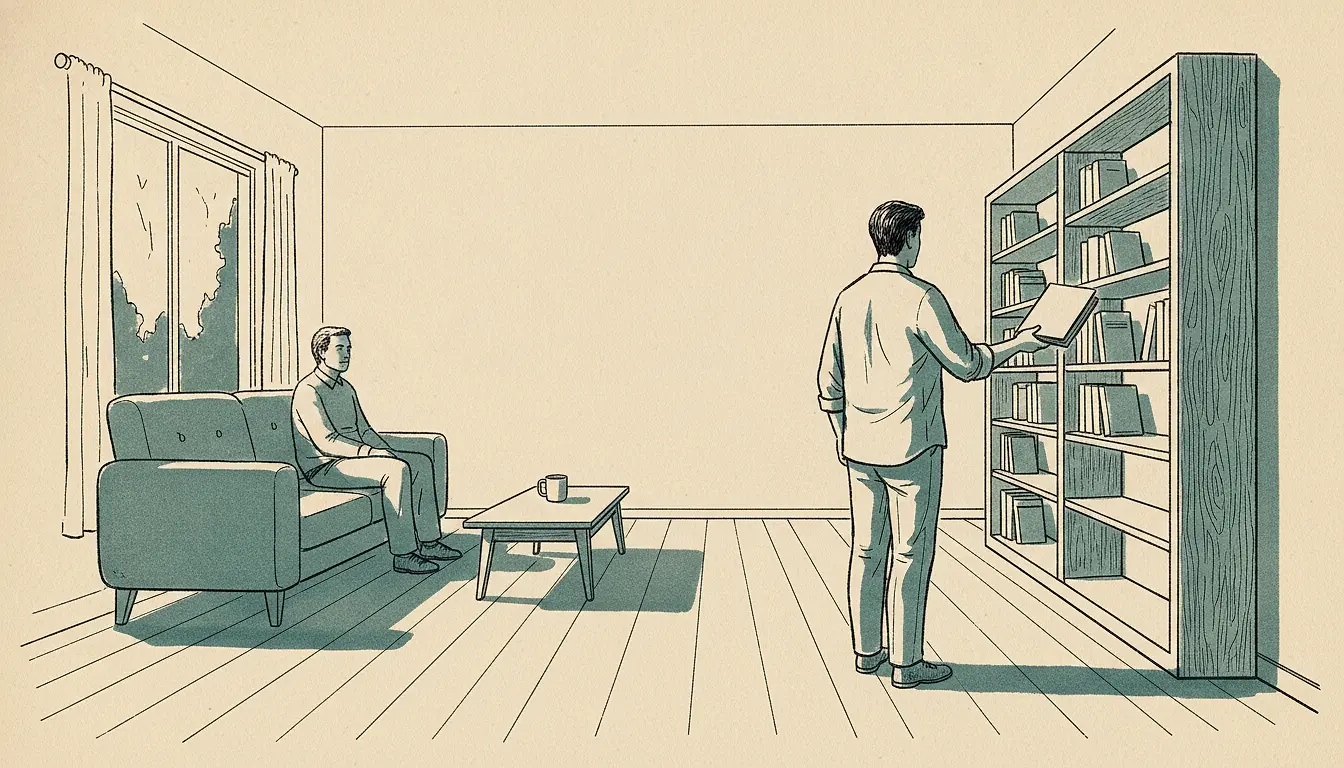
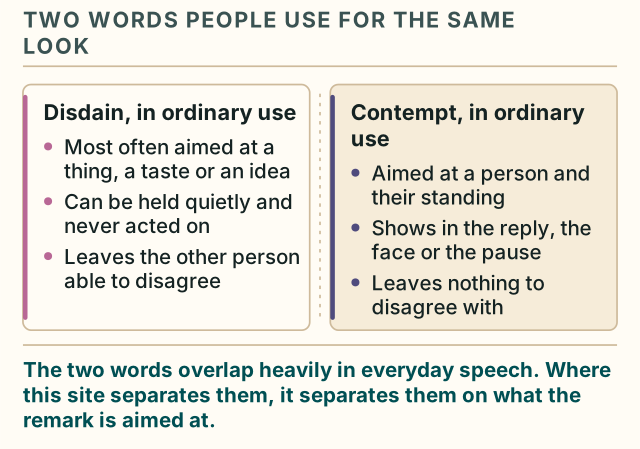
This is the thinnest distinction on this site, and it is worth saying so at the top rather than manufacturing depth that is not there. In the disdain vs contempt pairing, both words describe the same underlying position: the other person has been placed lower. Disdain is that position held quietly, as a withdrawal of effort. Contempt is that position expressed, so the other person and often a third party can see it.
The difference is real, but it is a difference of register and distance rather than of kind. Anyone who tells you the two words name two separate emotions is selling a taxonomy that ordinary English does not support.
| Disdain | Contempt | |
|---|---|---|
| The stance | The other person is below the threshold of effort | The other person is below you, and told so |
| How it travels | By absence — attention withheld | By expression — tone, mockery, correction |
| Who sees it | Often only the person feeling it, at first | The partner, and sometimes an audience |
| What it does to a conversation | Ends it early | Ends it, and adds a ranking on the way out |
What is the difference between disdain and contempt in one line?
Disdain withdraws; contempt announces. Disdain is the decision that something is not worth responding to, and its main evidence is what does not happen. Contempt takes the same judgement and puts it into the room — in the tone, the repeat-back, the aside to someone else.
Both are downward. That is what makes them near-synonyms and what makes the confusion reasonable. If a difference in kind is what you came for, this page will disappoint you honestly rather than invent one.
The two words also carry different social weight, which is a real difference even though it is not a difference in the underlying stance. Disdain sounds cooler and more literary; people apply it to themselves fairly readily. Contempt sounds like an accusation, and people apply it to other people. That asymmetry is worth knowing about, because it means the word you reach for is influenced by who you are describing as much as by what is happening.
What does disdain look like in a couple?
Disdain looks like effort being quietly withdrawn. It rarely arrives as an event; it shows up as a change in the size of ordinary responses. A story gets a shorter answer than it used to. A suggestion is met with agreement so fast it is clearly not consideration. An argument that once would have run for an hour now ends in a minute because one person has decided it is not worth the hour.
For example, a partner mentions something that happened at work. The disdainful response is not a retort — it is mm, and a return to the phone. Nothing was said that could be quoted back. But the withdrawal is legible, and that is the part people describe when they say the relationship went cold before it went bad.
Withdrawal of effort means giving less than the situation calls for, deliberately enough that the other person notices the gap, but not so explicitly that it could be raised as a complaint. That deniability is disdain’s characteristic property, and it is exactly why it is hard to talk about.
What does contempt add?
Contempt adds expression, an audience, and a record. The stance is the same one disdain holds privately; contempt puts it where it can be heard.
Signature
The same stance, quiet and out loud
Mm. Sure.
withdraws effortThe reply is technically an answer and structurally a refusal to have the conversation.
Right, because that worked so well last time.
ranks out loudThe sentence adds a judgement the quiet version kept to itself, and it is now on the record.
Tell them what you told me. Go on.
recruits an audienceThe ranking is performed for a third person, which is what makes it hard to answer without escalating.
Lines are composites written for illustration, not transcripts of real people. Naming what a line does is not a judgement about who said it.
The record matters more than it sounds. A withheld reply leaves nothing behind; a sentence said in front of a friend is remembered by everyone in the room, including the person who said it. That is the mechanism people are pointing at when they describe contempt as the harder of the two to walk back — not that the feeling is stronger, but that expressing it commits you to it.
Imagine the same evening running twice. In the first version, one partner says nothing and the conversation shrinks. In the second, the same partner says the sentence out loud in company. The feeling behind both evenings can be identical. Only one of them has to be accounted for the next morning.
Is disdain a milder form of contempt?
Mostly, yes — but mild describes the volume, not the position. Both words place the other person below the level at which their view has to be taken seriously. Disdain does it by giving less; contempt does it by saying so. Treating the quieter one as harmless because it is quiet misses that the two share a stance.
There is a second reason not to file disdain under harmless. Because it travels by absence, it is almost impossible to raise. A partner who says you were dismissive of me just now can be answered with I said nothing, and that answer is technically accurate. The thing being described is a gap — a reply that was shorter than it should have been, an interest that was not shown — and gaps are difficult to put on a table between two people.
Contempt has the opposite property. It is easier to name and harder to take back, because it left something behind. Which of those two is worse to live with is not a question this page can settle, and the answer probably depends on the couple rather than on the words.
Why does the word you pick matter?
Because the word you choose determines what you are describing — an act you might change or a person you have already sized up. Naming accurately here means picking the word that matches your behaviour rather than the one that sounds least damning about you.
Consider the difference between telling a friend I have no patience for him lately and telling them I said something in front of everyone I should not have said. The first names a mood; the second names an act. Only the second one gives you something to do next.
Calling it disdain when it is being expressed is a way of keeping the quieter word for yourself. Calling it contempt when it is still private can turn a mood into a verdict prematurely. Neither error is moral; both make the thing harder to describe to the person it concerns.
There is also a limit to how far accuracy helps. Naming what you feel precisely is a non-escalating move — it keeps a conversation about something specific rather than about a verdict — but it is a move, not a resolution. Choosing the right word does not tell you what to do with what the word describes, and any page claiming otherwise is selling you the easy half.
This page describes words, not people. It cannot tell you which one applies to your relationship, and it does not try. If you want the relational sense of the underlying term, what contempt means treats it directly; contempt versus resentment covers the other pairing readers ask about most; the whole pattern is on the main page, and what we cite is listed on sources.