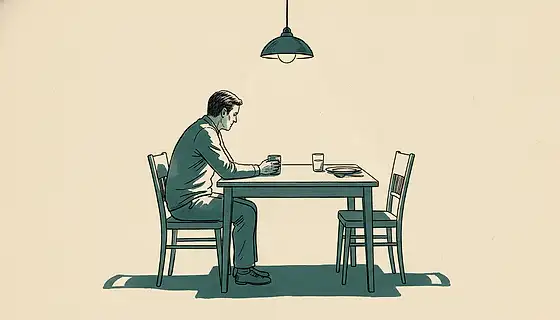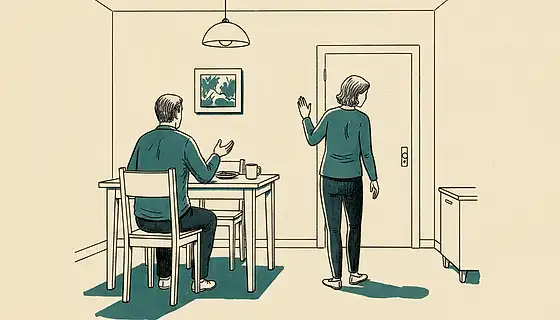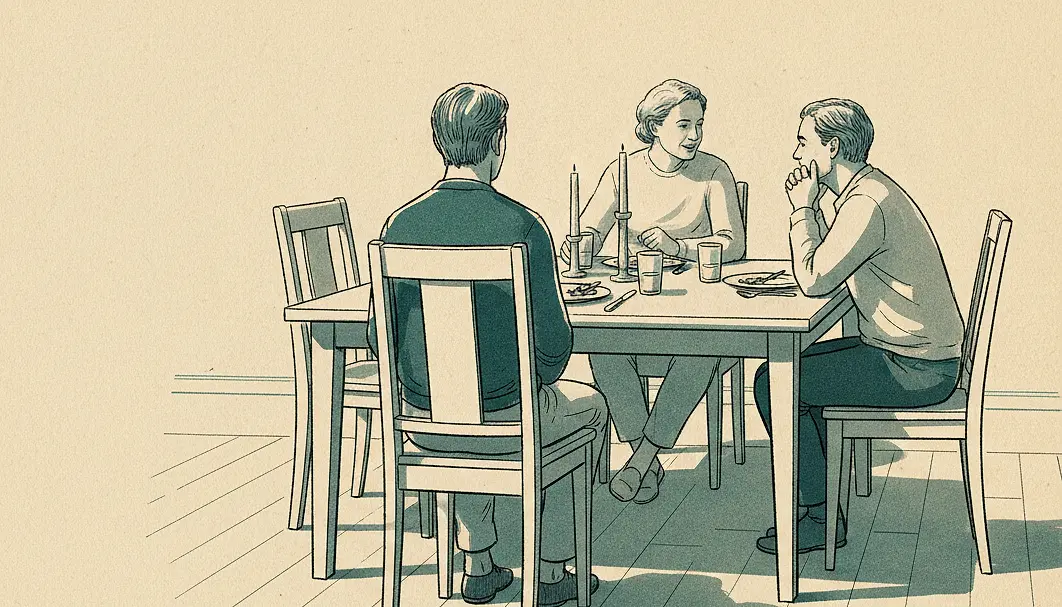
If you have searched something like my partner treats me with contempt, you probably already have the scene in mind and are looking for the word for it. Contempt from a partner is scorn delivered from above — mockery, sarcasm, mimicry, correction in front of other people, the eye-roll aimed at you while you are still speaking. It is not louder than an ordinary argument. It is usually quieter, and it is much harder to answer.
This page is about that difficulty and about the sentences that tend to work better than arguing back. It is not an assessment of your relationship, and it does not know anything about your partner.
Why is it so hard to answer?
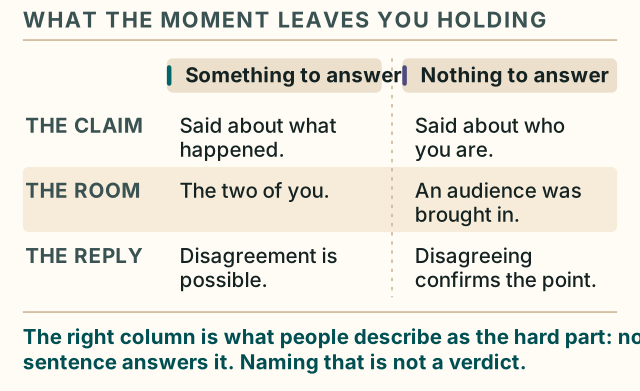
Because the argument you are being handed is not about the topic. Contempt is a complaint plus a position above you — the pattern the Gottman Institute names among the four horsemen — and the two parts do not behave the same way. The complaint can be answered — you can concede it, dispute it, or fix the thing tonight. The position cannot. There is no sentence you can produce that refutes a sneer, and no chore you can complete that changes someone’s mind about your standing.
That is why the reflex to defend yourself so often makes the evening worse. Defending is a move that assumes you are inside a disagreement between equals. Contempt has already stepped outside it. For example, if you are told “wow, you really thought that would work” and you answer with your reasoning, you have accepted the frame in which your reasoning is on trial, and the tone you were actually objecting to never got mentioned. Afterwards you are arguing about the thing, losing, and unable to say what went wrong.
The second reason it is hard is deniability. Most contempt is carried by delivery — timing, voice, face — and delivery is easy to disown. I was joking. You’re too sensitive. The objection gets converted into evidence for the ranking, which is exhausting in a specific way that people find difficult to explain afterwards.
What can you say?
Describe the behaviour, say what it did, and ask for one specific change. That order matters, and each part is doing a job.
Describe the behaviour, not the person. “When I was telling that story and you sighed and looked at Dan” is a thing that happened. “You were being contemptuous” is a verdict, and verdicts are answered with defences. Point at the smallest concrete piece of it you can identify — the sigh, the voice, the glance — rather than at the character behind it.
Say what it did, briefly. “I stopped wanting to finish the story.” Not an accusation, not a demand for guilt. Just the effect, in one clause. Long descriptions of hurt invite a debate about whether the hurt is proportionate, which is a debate you cannot win and did not want.
Ask for one change, narrow enough to agree to. “I’d like you to let me finish the story next time, even if I get the date wrong.” Narrow requests get agreed to. Broad ones — “I want you to respect me” — cannot be acted on tonight and tend to collapse back into the argument about whether you are respected.
Imagine the whole thing said at normal volume, later, not mid-argument: “When I got the date wrong at dinner and you corrected me and looked around the table, I stopped talking for the rest of the meal. Next time, can you let it go, or tell me after?” That is short, it is about one evening, and it can be answered with yes.
A few more things help. Pick the moment when nothing is currently on fire; contempt is almost never resolved inside the argument that contained it. And pick one example rather than the collected works — a list is heard as a case being built, and the reply to a case is a defence.
What usually does not work?
Matching it, defending against it, and keeping score. All three are understandable and all three tend to lengthen the pattern rather than interrupt it.
Matching it. Consider what happens when sarcasm is answered with better sarcasm: it feels like the only available justice, and it turns the exchange into a contest of altitude. Both people end up above the conversation and nobody is in it.
Defending. Covered above: it accepts the wrong frame. The particular trap is that defending works often enough to be tempting, because sometimes the complaint underneath really can be settled — and then the tone goes unmentioned again.
Keeping score. Keeping score refers to the private ledger of incidents kept for the argument where you will finally prove the case. It rarely gets used, and when it does the reply is an argument about the ledger. Meanwhile the ledger changes what you notice: after a few months of collecting, it is genuinely hard to remember an ordinary evening.
Explaining the framework. Sending a partner an article about contempt, this one included, is a move with a poor record. It arrives as a diagnosis with a source, and diagnoses are argued with. The specific sentence about the specific evening travels much further than a link.
How do you name a limit?
By deciding what you will do, not by issuing a demand about what they must stop. A boundary is a description of your own next action — the room you will leave, the conversation you will pause, the dinner you will not host — stated calmly and in advance. That framing, and the distinction between a boundary and an ultimatum, is the subject of Nedra Glover Tawwab’s Set Boundaries, Find Peace.
In practice it sounds unremarkable: “If the voice comes out, I’m going to stop the conversation and pick it up tomorrow.” Then, when it happens, you stop the conversation and pick it up tomorrow. The sentence is doing very little work; the doing is doing all of it. A limit announced and not kept teaches the opposite of what it says.
A caution, stated plainly. A limit is not a punishment and is not leverage — if it is designed to produce an apology, it will be heard that way and answered accordingly. And a limit is something you can only set over your own behaviour. You cannot set one over someone else’s face.
Where does this page stop?
Where this page stops. This page describes a pattern in how people talk to each other. It cannot tell you what is happening in your relationship, whether it is safe, or what you should do. It is not therapy and not a substitute for it. If you are frightened of your partner, a page is the wrong tool — talk to someone who can hear the specifics.
We want to be exact about one thing rather than vague about it. Scorn from a partner sits on a continuum, and the far end of that continuum is not a communication pattern any more — it is frightening, it is coercive, and it is outside what an editorial site about one conversational habit can responsibly describe. We are not going to tell you which part of that continuum you are on. Nobody who has not heard the specifics can. If reading this page raised that question for you, the useful next step is a person, not a page: a therapist, a doctor, a service in your own country, someone who can ask follow-up questions and hear the answers.
What this page will not do
- Tell you what your partner is
- We describe behaviour that people produce, not personality types that people are. No page here will label your partner, and a page that offers to is guessing about someone it has never met.
- Tell you to stay or to go
- That decision needs everything a web page does not have: your history, your circumstances, your safety, your children if you have them. We have none of it, so we have no opinion.
- Score your relationship
- There is no checklist here, no threshold, and no count that means something. Scoring instruments in this territory are wrong often enough to do real damage, and we are not qualified to run one.
- Put numbers on it
- Figures about contempt circulate widely in reworded form. Until we can verify one against the primary source that produced it, we describe the research in words and link it instead.
Where contempt comes from, when you are the one feeling it rather than receiving it, is on feelings of contempt. The specific lines and gestures are collected on examples of contempt, and the pattern as a whole is on the main page. Everything we cite is listed on our sources page.